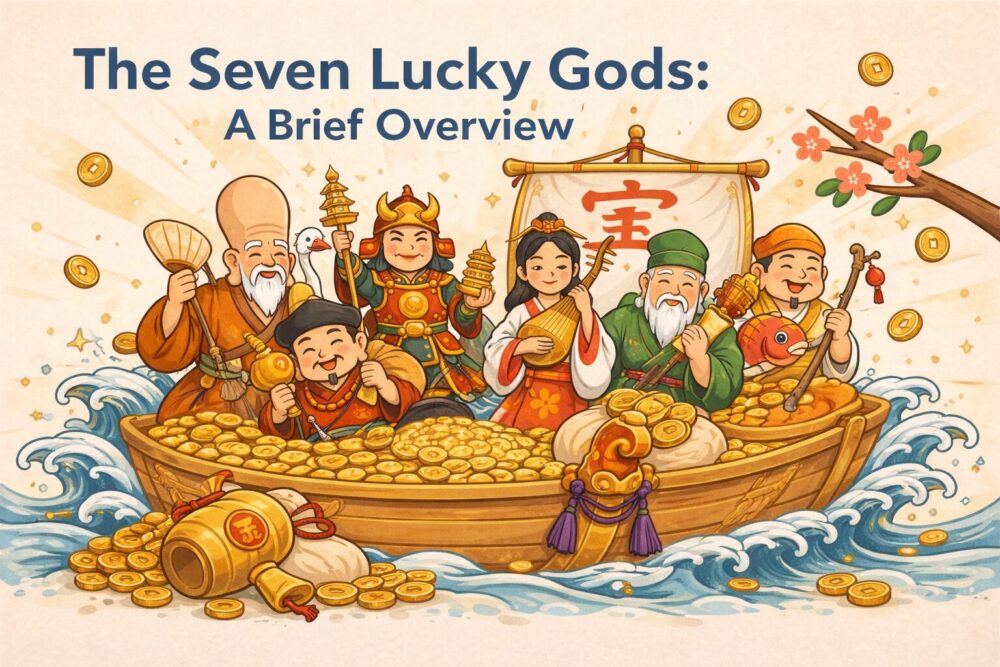
The Shichifukujin are a roster of Seven gods comparable to groups such as the Eight Immortals in Chinese religion. As a group, it is quite uncommon to have members originating from various parts of the world, this roster of gods is a unique phenomenon belonging to Japan! This article was based off of a Japanese original: https://jinjabukkaku.online/shichifukujin/
Other sources include:
『キャラ絵で学ぶ神道図鑑』
『イラスト図解でよくわかる!日本の神社・お寺入門』
What is a Fortune God?
Fortune gods, “Fukujin” in Japanese, is a category of gods that originated in the middle ages. In short, Fortune gods are a class of gods that are prayed to for a bountiful harvest and catch. They are gods that bring economic wealth to the people, in turn bringing them happiness.
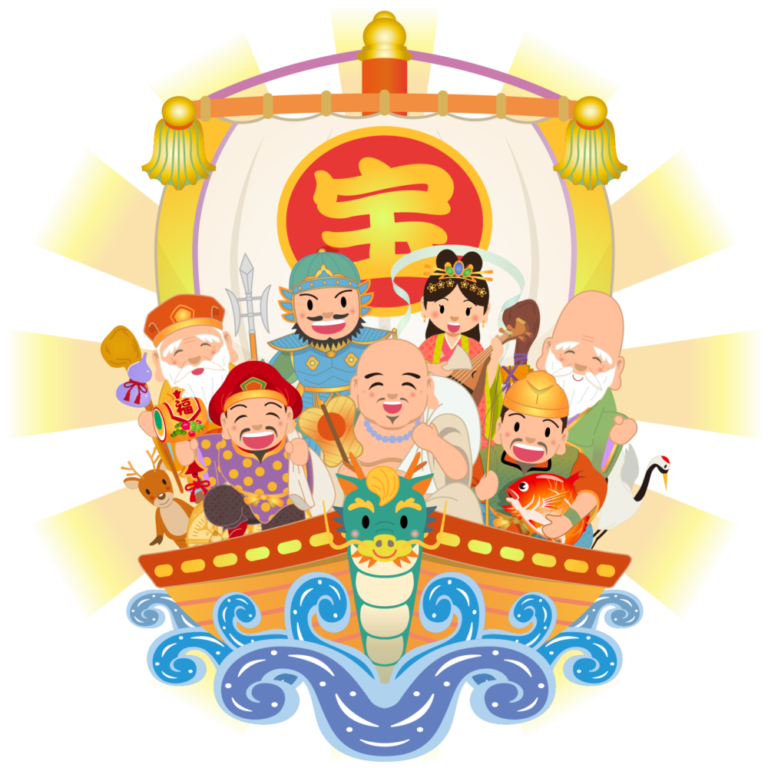
The iconic pantheon of seven are said to have been established in the late Muromachi period.
It is said that there is scriptural basis for the Seven Fortune Gods in the sūtras. In the Humane King Sūtra, there is a line which says “Seven disasters annihilated, seven fortunes arise”, the Seven Fortunes in question being the scriptural basis.
The Seven Fortune Gods are a peculiar pantheon of gods, as they are made up of deities from three different cultures. These include:
From India:

Daikokuten/Bishamonten/Benzaiten
From China:

Fukurokuju/Jurōjin/Hotei
And from Japan:

Ebisu
Daikokuten

Daikokuten, or Mahākāla in Sanskrit, is a deity that originated in India. Before we introduce more about him, here is a little quiz: Select all that is correct about the Hindu god Lord Śiva:
1) He occupies the highest position in Shaivic Hinduism
2) He is the god of destruction
3) He is the god of regeneration
(Answer: All of the above)
Mahākāla is said to be an incarnation of Śiva. Regarding his name, in Sanskrit, Mahā means great, and kāla can mean time, death or darkness. Thus, his name in Japanese, “Daikokuten”, means the “Great Dark Deva(deity)”.
Mahākāla is the god of destruction and prosperity. Initially entering Japan through the pantheon of Esoteric Buddhism, his imagery seems to have been syncretised with another deity of the local tradition. Ōkuninushi-no-mikoto, or “Daikoku”, is the main deity of the Izumo Taisha, and the god of nation building. He is an important god with many epics involving him. It is believed that since the sinic pronunciation of “大黒(Mahākāla)” and “大国(Ōkuninushi-no-mikoto)” are both “daikoku”, they were associated and fused with one another.
Another iconic imagery of Daikokuten that is believed to be derived from syncretism is his big hood (which is actually his wallet), and his association with kitchens. This seems to have originated from the “Records of the Travels on the Southern Sea”, an account of a monk’s travel to India.
In contrast to his Indian or even Tibetan depictions that are typically wrathful (and quite metal!), Japanese depictions of this deity are often quite benevolent and friendly. It is a unique interpretation indeed. As for his role within the Seven Fortune Gods, the primary benefit he offers is a bountiful harvest of grains.
Bishamonten

Bishamonten, or Vaiśravaṇa in Sanskrit, is also a deity that originated in India.
In Buddhism, he is also one of the Four Heavenly Kings (What a busy deity!). Known as “Tamonten” when in the set of four, he is often placed on an elevated platform in one of four corners. He is also commonly seen depicted in amulets.
Kubera, the god of wealth, seems to be the basis of this deity. Being the basis of a military god, Kubera unexpectedly has minimal association with combat.
Bishamonten’s domain is monetary luck and gambling luck (please gamble in moderation!).
Fukurokuju

Fukurokuju, Fulushou in mandarin, came from China.
He bestows upon us three virtuous blessings: fuku (children), roku (wealth) and ju (longevity). Naturally, his role in the seven are to provide these three blessings.
Fukurokuju is said to be the manifestation of the Southern Polar Stars.
Jurōjin

Jurōjin, Shoulaoren in mandarin, also came from China. He is likely to be the same person as Fukurokuju, and as a result, also a manifestation of the Southern Polar Stars.
As a result of that, when they are recognised to be the same character, another deity is brought in to fill in for the open seat in the seven (Often Kishōten or Shōjō).
In terms of imagery, Jurōjin is often often depicted with a bottle gourd (“hyōtan” in Japanese) and a deer by his side. Symbolically, the gourd represents the pill of immortality, while the deer represents longevity and harmony with nature. In his hand is a peach, and while it is known to have protective effects against evil spirits, it also has the effect of everlasting youth!
Of course, benefits of worshiping him include longevity and lasting youth.
Hotei

Hotei, or Budai in Mandarin, is from China like the previous two.
In fact, it is believed that he is an actual monk in the Chan/Zen lineage. There is even a widely held belief that Hotei is in fact an incarnation of the bodhisattva Maitreya (Miroku Bosatsu). He is sometimes also included in the roster of the famous “Eighteen Arhats”, though it is likely that the deity in each roster is not same person in the literal sense.
His name, Hotei, literally means “cloth bag”, and this is derived from the massive bag he carries on his bag. He is also depicted with a huge belly. His image is often confused with the historical Buddha, Śākyamuni, but they are not the same person!
The main benefit of worshiping him are material and spiritual wealth. Apparently, he is a very accurate fortune teller too!
Benzaiten

Benzaiten, Sarasvatī in Sanskrit, was originally from India. In India, she was the goddess of water, and beauty and oversaw beauty and harvest.
Regarding her name, the second character “s(z)ai”, means money (財), but this is only limited to when she is depicted in the roster of seven. Outside of that, her name is written with “才”, meaning talent, as in “Benzai”, or talent in debating.
She is often depicted with a Biwa (a type of Japanese string instrument), which symbolises her place as a goddess of music and performing arts.
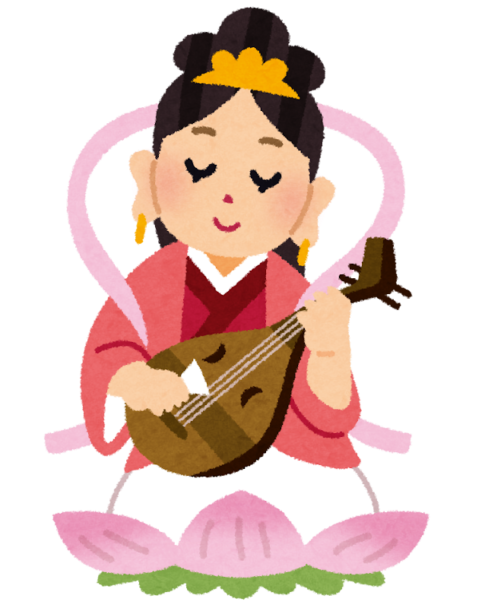
By the way, Benzaiten also has forms as a warrior goddess. The eight armed Benzaiten enshrined in the Meguro Shichifukujin Banryūji is one such example.
Benefits that Benzaiten offer include prosperous luck and improvement in artistic skills.
Ebisu

Finally, there is Ebisu. Surrounded by mystery, Ebisu is the only god in the roster that is native to Japan.
The mystery surrounding Ebisu is confounded by many things. This includes the kanji for his name, which differ greatly according to the source, with words meaning “savage” or “child of a leech” often being used. These aliases sound rather frightening (but really cool!).

However, what’s in common among all the mentions of Ebisu, is that he is associated with fishermen, and he grants wishes for a big catch. No wonder he is always depicted with a sea bream! According to Nishinomiya Jinja, regions with Ebisu devotion often have sea bream as their signature local produce.
His role in the roster is luck at sea and prosperity in sales.
Closing Thoughts
The Seven Fortune Gods are truly a fascinating roster of gods. It is very interesting to see that the gods that also appear in different cultures are interpreted differently in Japan. To the readers: What are your thoughts on the Seven Fortune Gods? Are there any similar rosters in your culture? We hope you enjoyed this article!
Trivia
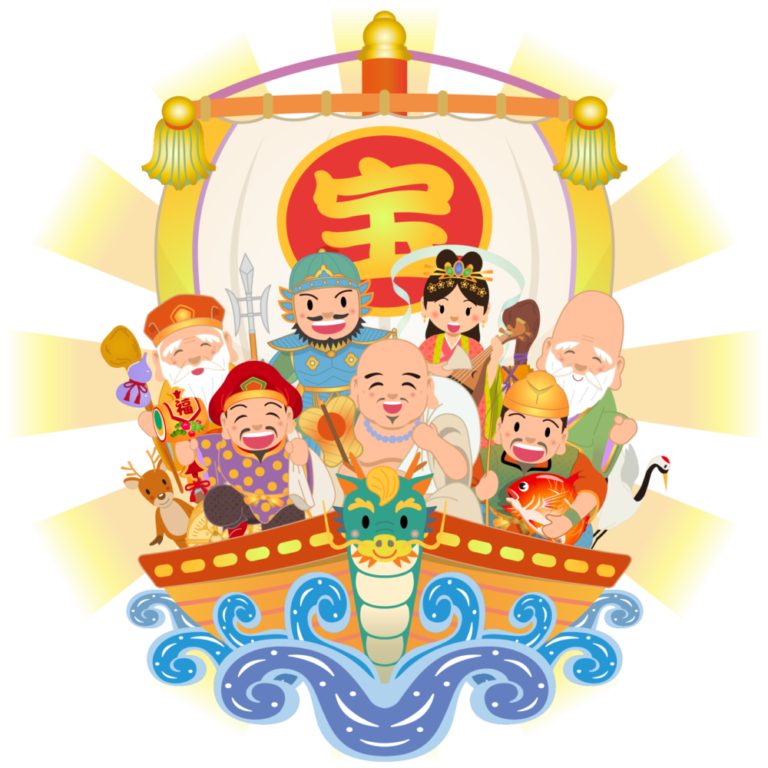
It is rumoured that if you place an image of the Seven Fortune Gods on board a jewelled ship, you will have a pleasant “hatsuyume”, the first dream of the new year.
Also, the reason why they are depicted as approaching by sea, is that it symbolises them bringing good fortune and happiness from the other shore.