A school you have likely not heard of!
What is Zen?
Though originally a Japanese word, English speakers are probably familiar with “Zen”. Nowadays, it is essentially a part of the English lexicon, synonymous with concepts like mindfulness and calmness, hippie, spirituality stuff in essence.
Apart from its popular connotations, the learned reader will probably know the meaning of Zen in the context of Buddhism. As a school and practice, Zen is perhaps the most widely known and studied aspect of Buddhism in the west, in large part due to the works of the late D. T. Suzuki. Zen, derived from the go-on pronunciation of the Chinese transliteration of Sanskrit “dhyāna”, which, can be grossly understood as meditative absorption. Zen, as a practice, is thus built around meditation, and the Zen Sect (zenshū) is a sect that specialises in the practice of Zen.
Ōbaku Zen
Those acquainted with Japanese Zen might be aware that there are two main popular schools, the Rinzai and Sōtō sects that have slightly differing interpretations of what Zen entails. But did you know that there is a lesser known third school of Japanese Zen?
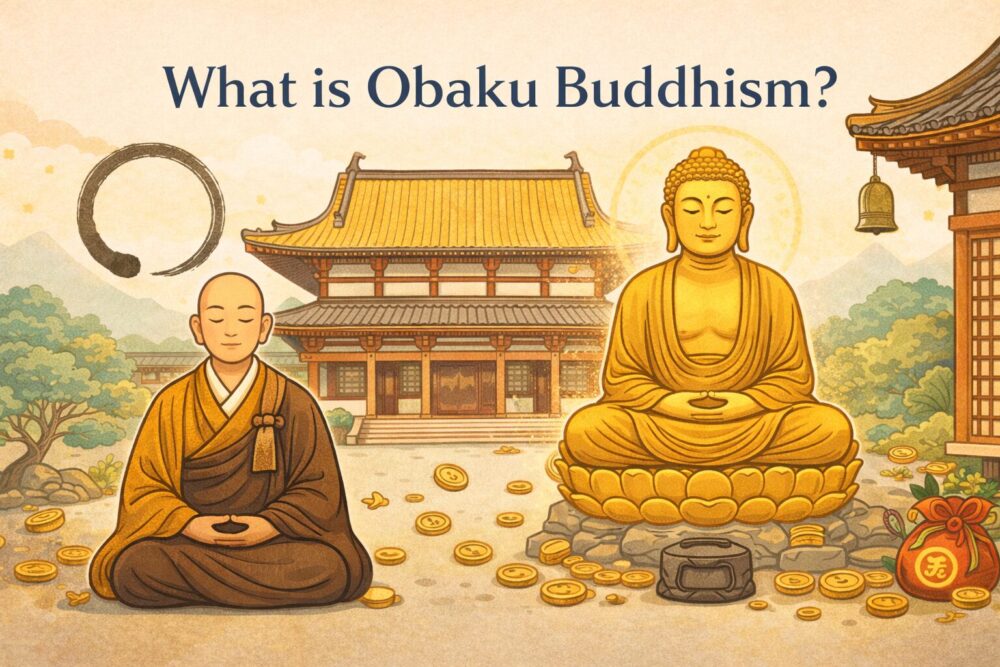
Enter: the Ōbaku school of Zen
Unlike the other two schools which were introduced to Japan in the 12-13th century Kamakura period, the Ōbaku school was introduced much later, in the Edo period in 1654. Why was a new school introduced at such a late period in the development of Japanese Buddhism? One of the reasons provided by Venerable Fujioka from Jōjuji, Zen Buddhism was in a time of crisis and decline in the early Edo period, after the long and brutal Warring States period. Since Chinese Zen (or Chan) is in its peak in China at the time, Ingen, a Chinese monk from the Fujian province in China, was thus invited to Japan by Japanese Rinzai monks to revitalise the local Zen tradition.
Japan at the time was under the “sakoku” regulation of protectionism, where foreign imports, including cultural imports, were strictly prohibited. Ingen, however, actually received an exemption from the Fourth Shogun Tokugawa Ietsuna himself, and was granted the Manpukuji in Uji as his headquarters in 1661.
Unique Chanting!
To the Japanese learners or speakers, some of you may already know this, but have you ever wondered why a single kanji can often have so many pronunciations?
Kanji often represent both native Japanese pronunciations (kun’yomi) and borrowed Chinese pronunciations (on’yomi). Yet even the Chinese pronunciations can be further categorised into three versions:
1. Go-on, the oldest and first interpretations of Chinese pronunciations in the Japanese language. There are many stories of its origin, but a common belief is that it is based on the Korean pronunciation of Southern Chinese dialects. This is more common in Buddhist and legal terminology in modern times.
2. Kan-on, the second and more widely used pronunciation today. This was brought back to Japan in the Nara/Asuka period by Japanese envoys who went to Tang China, and is based on the pronunciation used in the Chinese Imperial Courts at the time. There was a push by the government to standardise Kan-on as the official pronunciation at the time, so it has become the more common pronunciation over time.
3. To-on(To-in), the third and least common form of pronunciation among the three. This is based on the pronunciation used in the Song Dynasty, and unlike the previous two, it was not a systematic set of pronunciations that was brought over, but pronunciations accompanying specific fragmentary words.
Interestingly, Ōbaku Zen uses the To-on pronunciation for their recitation of Sūtras. Due to it being an interpretation of later forms of Chinese, is very similar to the Mandarin pronunciation in Chinese recitations, and is a different flavour to usual Japanese recitations. Feel free to check out some videos and hear it for yourself!
Closing thoughts
Being a late entry to the world of Japanese Buddhism, Ōbaku Zen brought with it many updates and new items like food from China. It is a very interesting Sect of Japanese Buddhism, and definitely a name that ought to come to mind when discussing Japanese Buddhism!